Showing posts with label News. Show all posts

Saturday, June 23, 2012

Apple’s Retail Army, by the Numbers

There was an article published today in The New York Times entitled ‘Apple’s Retail Army, Long on Loyalty but Short on Pay‘, discussing what the publication asserts is a huge disconnect between the money Apple retail employees make and the amount they bring in for the company.
This is the fourth part of The New York Times’ long-running iEconomy series, the earlier portions of which took a deep dive into Apple’s manufacturing processes in China and the reasons Apple doesn’t manufacture in the U.S.. Those caused a wave of discussion over the issues, which you may remember was later muddied by the revelation that monologuist Mike Daisey had fabricated some of his experiences in China, which he included in an editorial for the same paper. Even before those articles, Apple had been working to audit working conditions in China and now supplies monthly updates on its efforts to improve them.
I’m frankly not all that convinced of the overall premise of this particular article, although I have spoken to many members of its retail workforce which do back up what is said about working conditions there. Specifically, since the iPhone was released in 2007, there has been a major change in the day-to-day workload of retail employees. The emphasis is now on replacement of devices and speed, with some technicians juggling up to three or more customers at a time.
There are a lot of interesting tidbits in the article about the Apple Retail Store environment though, and I’ve collected a few here:
  • 30,000: Out of 43,000 Apple employees in the U.S., about 30,000 of them work in Apple Retail Stores and make around $25,000 a year. Though discussions with workers and others lead us to believe that number is a bit lower than the current reality.
  • $473,000: On an average, Apple store employee’s including sales and support staff, brought in $473,000 each for Apple last year.
  • $5,647: By RetailSails numbers, Apple’s stores brought in $5,647 per square foot, more than any other U.S. retailer.
  • $11.91: Many Apple retail workers earn around of $11.91 hourly, although we’ve heard this is on the low end. It also does not take into account recent wage increases.
  • $16B: Apple stores worldwide sold $16 billion in merchandise last year.
  • $3M: The best performing sales people at Apple stores can move as much as $3 million in wares in a year.
  • 2.5 years: The average tenure for an Apple retail employee is is 2.5 years.
  • 6 years: The tenure that Apple recruiters tell new employees that they would like to see from them.
  • 90%: The average year-over-year retention rate for Apple Geniuses, or technicians.
  • 65%: Although there are no commissions at Apple stores, both Apple Care and One to One training sessions are tracked in order to gauge performance. Employees are expected to achieve a 40% ‘attachment’ rate of training and 65% rate of Apple Care sales for products.
For me, the article’s basic premise, that Apple workers should be earning more because the company makes so much money, falls apart right on the first page, with this passage:
By the standards of retailing, Apple offers above average pay — well above the minimum wage of $7.25 and better than the Gap, though slightly less than Lululemon, the yoga and athletic apparel chain, where sales staff earn about $12 an hour. The company also offers very good benefits for a retailer, including health care, 401(k) contributions and the chance to buy company stock, as well as Apple products, at a discount.
Holding Apple to a higher standard because it is so successful makes for an interesting discussion, but most of the things that the article says about Apple can be said of almost any retail job. The article also makes some odd comparisons between Apple and other retailers that offer commission, which Apple does not do.
It also compares the money Apple workers bring in to those working at Costco and Tiffany’s, both of which are bizarre for their own particular reasons. Tiffany’s because diamonds are a significantly different retail item than consumer electronics, with massively different margins, and Costco because memberships bring in an immense portion of that company’s profits.
Apple itself provided a statement to the Times:
Thousands of incredibly talented professionals work behind the Genius Bar and deliver the best customer service in the world. The annual retention rate for Geniuses is almost 90%, which is unheard-of in the retail industry, and shows how passionate they are about their customers and their careers at Apple.
As we were able to confirm earlier this week, many Apple Retail employees received a raise of up to 25% after their personal performance evaluations this year.

Here’s a geeky ranking of Latin America’s most connected airports

The digital marketing agency Ressac has released an interesting report about Latin America’s main airports. Rather than looking at passenger traffic, it decided to set an entirely different set of criteria – and find the region’s most connected hubs.
Titled “Aero-Social Ranking 2012,” the study was conducted by Ressac’s intelligence department during 2012′s first quarter. What makes it interesting is that it went beyond checking whether or not airports offered the free wi-fi connection we all dream of; as a social media firm, the company also took into account each airport’s presence on Facebook, Twitter and the like. In addition, it also looked into accessibility, attributing extra points to airports that had an app or mobile-friendly website.
Unfortunately, the results are fairly disappointing in many respects – for instance, travelers will still have to pay for wi-fi in most airports. As for social networking, while some airports are using Twitter, very few of them are present on Facebook, YouTube, Flickr and Foursquare.
Still, some airports fare way better than others when it comes to connectivity, with Argentina’s Ezeiza International Airport leading the regional ranking. Here are Latin America’s top airports according to Ressac:
airport ranking latam 520x410 Heres a geeky ranking of Latin Americas most connected airports
In other words, while the region’s airports still have progress to make, some of them are starting to adapt to the needs of modern travelers. As for Ressac, it now hopes that its document will serve as a checklist for other airports to follow the same path.
Image credit: Gisela Giardino

Google Doodles Alan Turing, the father of computing

Today, marks the 100th anniversary of Alan Turing, who is universally considered the father of modern day computing. And in true Google, style, the search giant has honored the legend, on it home page with a trademark doodle.
Turing, in particular is a role model for a number of Google engineers and the doodle honoring him is an interactive doodle, which requires users to break a set of six codes and each successful code break adds color to a letter of the greyed out Google logo on the doodle.
The British mathematician laid the foundations for mathematical foundation and limits of computing. He was also a key contributor to the Allied cryptanalysis of the German Enigma cipher during World War II.
He was born on June 23, 1912 in London, England and he graduated with mathematics from King’s College, University of Cambridge in 1934.
He joined the British government’s Code and Cypher School in the second world war and later he was made an officer of the Order of the British Empire for helping break the cryptic messages used by the Germans during the war.
After the second world war the National Physical Laboratory (NPL), where he designed the electronic computer. Eventually, he quit the NPL to head the Computer Machine Laboratory, where he designed the Ferranti Mark I, which was the first electronic digital computer to be commercially available.
Alan Turing was also a pioneer of in the field of Artificial Intelligence (AI) and in 1950 he proposed the Turing test to extrapolate whether a machine can think.
His career went through many ups and downs and he hit a plateau when he was convicted of gross indecency under laws, which banned homosexuality and was sentenced to chemical castration involving a series of injections of female hormones.
After losing his security clearance he was unable to work which lead to committing suicide at the age of 41 in 1954.
The genius of the man cannot be underestimated and frankly but for his work, we perhaps would have been living in a very different world. Google has also dedicated a whole blog post to his work, make sure to check out the link.

Friday, January 6, 2012

Devour data much? Apple's Siri surely does

Apple's iPhone 4S is a major data user.
(Credit: Apple)
iPhone 4S owners are most likely to consume boatloads of data, a new study from mobile network management company Arieso has found.
According to the company, iPhone 4S owners use twice as much data as iPhone 4 users and three times as much data as iPhone 3G owners. In the company's 2010 study, the iPhone 4 was the top data user.
How did the iPhone 4S take the crown, you ask? Simple, says Arieso chief technology officer Michael Flanagan in an interview published today by Bloomberg: Siri.
Apple's virtual personal assistant, which lets users find content from the Web, schedule appointments, and handle other tasks via voice commands, has been a welcome addition for folks trying to do more with their smartphones. But it has also proven troublesome on the data front because of its regular connections with Apple servers and the Web. In addition, Flanagan said, the iPhone 4S regularly connects with Apple servers to sync content, making it more likely to use data.
The implications of that data usage are huge for both consumers and carriers. Consumers have been forced into tiered data plans by many carriers, including AT&T and Verizon, limiting how much content they can consume each month. If they exceed their data limits, consumers are often hit with hefty fees just to get more data.
Although tiered data plans have been criticized, carriers justify the decision by saying that the move is designed to improve the overall quality of their networks, which are crumbling under the pressure of heavy usage. Back in August, Validas, a company that analyzes cell phone bills for consumers, announced a study that looked at mobile data usage by customer. According to the firm, the average AT&T customer was using 116 percent more data in June than they were in July 2010. Verizon and Sprint saw their data usage per user jump by 150 percent and 69 percent, respectively. T-Mobile had average data usage drop by 2 percent.
That said, Arieso's study finds that only a relatively small number of users are consuming massive amounts of data. In fact, Arieso reported, just 1 percent of all mobile subscribers consume half of all downloaded data, and that would seem to indicate that Validas' study doesn't necessarily paint the whole picture.
"The introduction of increasingly sophisticated devices, coupled with growing consumer demand, is creating unrelenting pressure on mobile networks. The capacity crunch is still a very real threat for mobile operators, and it looks set to only get harder in 2012," Flanagan said in a statement. "The mobile industry needs new investment and new approaches to boost network performance and manage the customer experience."
As Arieso notes, it's not just the iPhone 4S that's to blame for heavy data usage. The company found that Samsung Galaxy S users consume 199 percent more downlink data than iPhone 3G owners. What's more, on the uplink side, HTC's Desire S beats out even the iPhone 4S, trumping iPhone 3G uplink data usage by 323 percent.
According to Bloomberg, Arieso conducted its study on a European network. It analyzed data from 1 million subscribers.

Tuesday, January 3, 2012

Twitterize Yourself makes visual sense of big data


A tool from Visual.ly that analyzes and visualizes users through Twitter posts demonstrates one way make easy-to-understand visualizations of big data.
One example of the increasingly important trend of combined analysis and visualization is evident in Visual.ly Labs' Twitterize yourself application, which provides a good representation of how companies can use large data sets to quickly identify user characteristics to increase engagement or upsell goods and services.
I spend most of my time in my day job looking at data across the extended software development life cycle (design, develop, deploy, maintain, etc.), looking for the patterns that show how software goes from design into development and then into production, and observing how the data sources interact with each other.
We recently identified more than 60 sources in which developers and operations teams might be interested, not including e-mail, existing social networks, and other tools they personally use.
Of course, not everyone uses every data source, but the mixing and matching of data across boundaries has introduced a whole new world of complexity and a need for analytics that help make sense of data--regardless of the type of data, or the people or machines that generate it.
There is so much data from so many sources that it becomes more and more critical for companies to start looking at their data analysis strategy early on in the product development process in order to best take advantage of the information available.
The important thing to keep in mind about all of the data you collect is that it should add intelligence to your processes. Whether you're trying to sell more product, make better decisions, or take actions faster, the data you gather is what should drive everything your business does. (Note: this is a great focus area for startups)
Visual.ly's tool uses data from your tweets, combined with data from Infochimps, a data access provider to help form a picture (literally and figuratively) of you as a Twitter user, including key statistics and a partial personality profile.
The "outfits" and "accessories" are chosen based upon keywords most associated for you. For example, if you tweet a lot about wineries, you will see a wine glass in your hand. Go to the ballpark often? Then your avatar will be dressed in a sports jersey, and so on. There are a total of 11 possible outfits that depict your overall Twitter personality and 29 different accessories that could be assigned to show your interests.
While it's certainly fun to have an infographic of yourself--especially one that dresses somewhat like you--the more interesting parts here are how much data is already out there about you and how much more analysis could be done, if you aggregate a bit more data. The University of Vermont, for example, recently analyzed some 46 billion words tweeted by 63 million users since 2009 to reveal that we are less happy than we were two years ago.
Think about being able to correlate your Twitter profile score with Amazon purchases, Facebook updates, credit card charges, or other consumer-oriented transactions. The data trail is extensive, and over time, companies are going to get better and better at making sense of it all. (And yes, you should be at least a little bit afraid of that.)
The challenge for businesses is that the tooling for this type of analysis is still pretty difficult to use, if available at all. If you consider that each site mentioned above is a silo, you'd first have to aggregate all of the different data sources, then run analysis against the full set, and then against subsequent smaller data sets (by user, group, location, etc.) to reveal the most relevant findings.

Sunday, December 25, 2011

Anonymous claims hack on security think tank

Stratfor's site is down for now.
(Credit: Screenshot by CNET)
Anonymous is claiming to have stolen 200GB worth of data, including e-mails and clients' credit card information, from a U.S.-based security think tank, the Associated Press reported today.
The hacking group also used Twitter to post a link to a list of clients apparently belonging to think tank Stratfor Global Intelligence.
"Not so private and secret anymore?" read one of numerous tweets from AnonymousIRC, a Twitter account linked to Anonymous.
This morning Stratfor's site was down. A notice reads: "Site is currently undergoing maintenance."
Anonymous also tweeted that it has "enough targets lined up to extend the fun fun fun of LulzXmas throught the entire next week." Lulz is a reference to a related hacking group known as Lulz Security
Stratfor apparently said in an e-mail to members that it had suspended its servers and e-mail following a hack.
"We have reason to believe that the names of our corporate subscribers have been posted on other web sites," said the e-mail, which was obtained by the Associated Press via subscribers. "We are diligently investigating the extent to which subscriber information may have been obtained."
Anonymous claims it was able to steal the credit card data because it was unencrypted.
"If Stratfor would give a s--- about their subscriber info they wouldn't store CC/CCV numbers in cleartext, with corresponding addresses," according to one tweet.
Stratfor's long list of clients includes the U.S. Army, U.S. Air Force, and Miami Police Department, the AP reported.

21,000 domains transfer out of Go Daddy in 1 day

Domain registrar Go Daddy lost over 21,000 domains yesterday. It could be a coincidence--or it could be the result of the company's p.r. debacle over its support for the Stop Online Piracy Act.
Yesterday, Go Daddy actually reversed course and dropped its support for the controversial legislation. "Go Daddy will support it when and if the Internet community supports it," Go Daddy CEO Warren Adelman announced in a statement.
SOPA, introduced in Congress this fall, would make it easier for the Justice Department to shut down sites allegedly dedicated to piracy.
An anti-Go Daddy thread on social site Reddit led to the creation of Godaddyboycott.org, a site set up to let people amass their disapproval with the company's support of SOPA.
While 21,054 domains transferred out Friday of Domaincontrol.com--which is managed by Go Daddy--it is only fair to note that 20,034 transferred in the same day, according to domain tracker Dailychanges.com
According to techie site TheNextWeb.com, though, the transfers-out have been building over the course of the week, with 8,800 reported on Monday and 14,500 on Wednesday.
Go Daddy did not immediately respond to CNET's request for comment.
(Via TheNextWeb)

Friday, December 23, 2011

Flurry: Largest Addressable Markets For Mobile Developers In 2012 Include India, China, Japan & U.S.

12-23-2011 7-07-00 AM-resized-600
Mobile analytics firm Flurry is closing out the year with a look into the forthcoming shift in mobile installed bases expected in 2012. Using data from the firm’s dataset of over 140,000 apps running worldwide, it was able to calculate smartphone penetration in established markets like U.S. and Europe. Then, using additional data from the IMF in combination with Flurry’s own data, the firm was able to then determine which countries represented the top market opportunities for mobile app developers.
Not surprisingly, China and India made the list. But so did the U.S.
To start, Flurry looked at a snapshot of apps running across its user base over the past 30 days in order to rank the current addressable market. The U.S. led the way, with an installed base of 109 million out of 264 million (41%). Flurry notes that 264 million is about half of what Apple and Google say they’ve activated – something that can be accounted for by old device replacement.
China (#2) and South Korea (#4) appeared in the top five, ranking above Japan (#5), France (#6) and Germany (#7). The U.K. is #2.
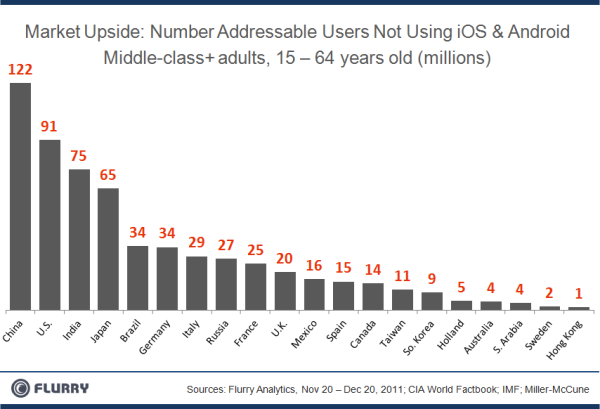
Next, Flurry wanted to determine which markets hold the most future promise. It used the adult population counts from the IMF, then adjusted the numbers based on the size of the middle class in each country using a study by Miller-McCune. Flurry then estimated the size of the upper class for each country, as those folks could also afford a smartphone. This way, China, India and Brazil would not be over-represented in the estimations just because they have large populations.
And yet, they did make a showing. China has 122 million users who could afford an iPhone or Android. The U.S. has 91 million, India 75 million, Japan 65 million and Brazil 34 million.

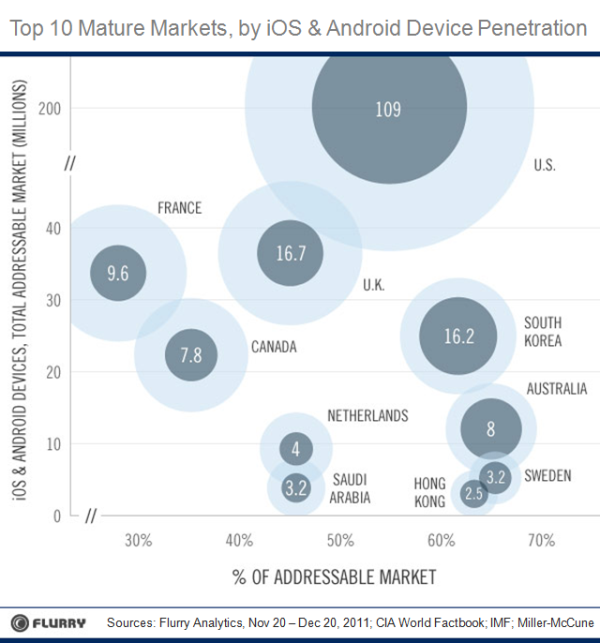
In the final bit of analysis, Flurry wanted to determine the world’s largest addressable markets, regardless of penetration. For starters, it looked at current market maturity (the measure of how penetrated smartphone devices are among a country’s addressable audience.)  The U.S., with the largest light blue circle in the graph below, has the largest total addressable audience (TAM) at 200 million. Sweden is the most mature country with 3.2 million of 5 million (66%) addressable consumers already using iOS and Android devices.  France, 10th in maturity, has 9.6 million of 34 million (28%) consumers using iOS and Android devices.

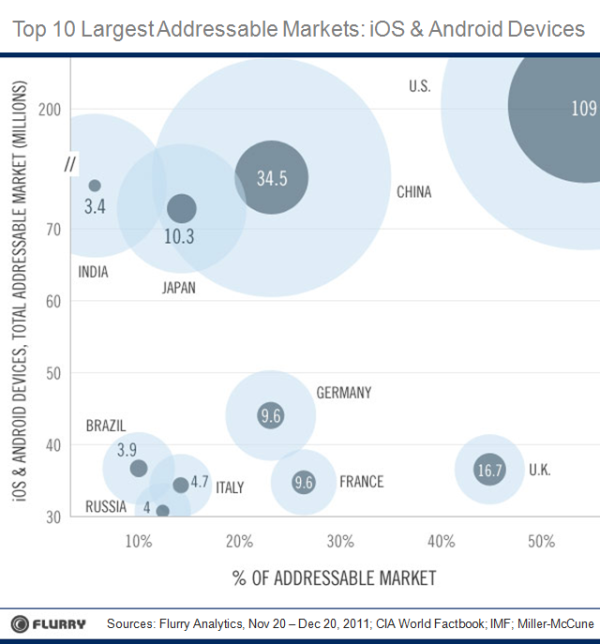
In looking at the future addressable markets, Flurry found that even though India’s total population is not far behind China’s, its total addressable market is. Meanwhile Japan, the world’s fourth largest market, has a lot of upside given light penetration of iOS and Android devices against its large, addressable market, says Flurry.

Using this method, the top 10 addressable markets are the U.S., China, Japan, India, Germany, Brazil, Italy, France, the U.K. and Russia.
More analysis can be found on Flurry’s blog post.

Monday, December 19, 2011

Silicon Island: What Cornell’s New York City Tech Campus Will Look Like [Images]

1319500926-cornells-proposed-nyc-tech-campus-sunarcdiagram-004-w1280-h1280-1000x692
New York City refers to its tech scene as “Silicon Alley,” but now it’s getting a giant new Cornell tech campus… on an island, between Manhattan and Queens. I’m going to leave the naming issue for the locals and share some images from the new campus — which is going to be quite impressive, judging by the few details available in an October article from architecture web site Arch Daily.
Beyond the larger goal of making the city more of a tech hub, the focus will be creating a “sustainable landmark” on the 2 mile by .15 mile landmass on the East River, the article explains. A quarter of the 2 million square foot campus will be green space available to the public, while the sun-oriented layout will include the largest solar panel array in the city. That’s not all on the environmental front. There’ll be four acres of geothermal wells, and a 150,000 square foot main academic building with a net-zero energy footprint.
In terms of transportation, the island is also going to be getting some upgrades, with the city already providing $100 million for improvements. Ferries, a tram line, a one-way bridge exit, and a single subway stop are the main ways to get on and off of it now. As The Atlantic explores today, maybe could even be a pedestrian and bicycle bridge to Manhattan?
With that, on to the renderings of the new campus by the prestigious architecture firm that Cornell has hired, Skidmore, Owings and Merrill LLP.


And the dreamed-of bike bridge:

Beware of potential Christmas scams

Although a number of people are out looking for the latest deals on gadgets that Apple and others may offer, scammers are in no doubt interested in capitalizing on the increased interest in purchases and promotions.
E-mail scams and other attempts to coerce people into giving up personal information online is nothing new, however, scammers may make extra effort to use Apple's popularity.
Scams like this one might find themselves into your mailbox. Be aware and avoid any offers that are too good to be true.
(Credit: Screenshot by Topher Kessler)
Recently, MacFixIt reader Martin F. wrote in about a scam e-mail he received regarding an Apple promotion, which, while obvious to many people as a scam, might be enough for others to fall for it.
The e-mail claims it is from Apple Christmas Awards, and mentions that the recipient is a promotions winner. The e-mail is from an account at "rediffmail.com," which would be the first sign it is not an official Apple e-mail. Additionally, the e-mail asks you to open an attachment, which is a Microsoft Word document.
While the document does not appear to have any malware associated with it, its content is quite obviously a scam. Underneath a large Apple logo, it claims that Apple has created a million iPhone 4S units in commemoration of Steve Jobs, and that winners were selected at random to both receive the phone and an award of around $2 million, from a pool of $250 million that Apple has set aside for this "promotion."
This scam is so poorly done it is almost amusing, but it does serve as a reminder that you may receive such offers and scams both via e-mail and other options throughought this holiday season, some of which might appear to be legitimate offers and promotions. Many of these will likely include malware, but even if they don't, they are designed only to steal your personal information.
Any legitimate offer from a company will have an official Web page at the company's Web site, which you can visit or call to get information on. Ensure you always visit or call the company to confirm the legitimacy of a promotion before accepting it, and never blindly give your information to anyone via e-mail.
And as always, to all the Grinches out there, "You're a three-decker saurkraut and toadstool sandwich, with arsenic sauce!"

Stanford Law Review: SOPA Unconstitutional, Would Break The Internet

protect_ip_21
The Stanford Law Review has posted a concise and informed takedown of SOPA and PROTECT-IP, the bills currently creeping their way towards votes in their respective legislative bodies. They make many of the same objections I brought up in my article Kill Switch, but with fewer words and more authority.
The piece was authored by Mark Lemley, David S. Levine, and David G. Post — from Stanford, Elon, and Temple Universities respectively — and touches on a few finer legal matters, such as the acts’ nullification of due process and the questionable constitutionality of the whole thing.
It’s brief and worth a read, but here are a couple highlights:
Directing the remedial power of the courts towards the Internet’s core technical infrastructure in this sledgehammer fashion has impact far beyond intellectual property rights enforcement—it threatens the fundamental principle of interconnectivity that is at the very heart of the Internet.
The Supreme Court has made it abundantly clear that governmental action suppressing speech, if taken prior to an adversary proceeding and subsequent judicial determination that the speech in question is unlawful, is a presumptively unconstitutional “prior restraint.” In other words, it is the “most serious and the least tolerable infringement on First Amendment rights,” permissible only in the narrowest range of circumstances. The Constitution requires a court “to make a final determination” that the material in question is unlawful “after an adversary hearing before the material is completely removed from circulation.” The procedures outlined in both bills fail this fundamental constitutional test.
At a time when many foreign governments have dramatically stepped up their efforts to censor Internet communications, these bills would incorporate into U.S. law a principle more closely associated with those repressive regimes: a right to insist on the removal of content from the global Internet, regardless of where it may have originated or be located, in service of the exigencies of domestic law.
Strong words, but this bill is strong medicine. The New York Times and Reuters both posted some commentary related to lask week’s discussions and some choice excerpts from the bills’ proponents. I like Fox Filmed Entertainment’s Tom Rothman’s chestnut that “Our mistake was allowing this romantic word — piracy — to take hold.” While I agree that sometimes the lexicon can affect social trends, I don’t think that people really conflate illegal online activities with adventure on the high seas.
As you may know, SOPA was recently in the House Judiciary Committee and delayed on account of dozens of objections and amendments, almost none of which were accepted. But instead of being delayed until January, which would give time for both sides to further entrench themselves, another session was scheduled for Wednesday, at which time it is expected to be approved for reading and vote in the House.
Once there, it could still fail to pass, and then there is the threat of veto, but Obama has been quiet on the issue. It’s odd, considering the administration was very clear about its position on net neutrality.
As in some other debates, all the experts and those with no financial involvement are lining up on one side, and threatened business interests are lining up on the other. It may be too late to affect the vote of your representative, but it can’t hurt to forward articles like the Stanford Law Review one, which could make for powerful ammo in a floor debate.

Thursday, December 15, 2011

Google's project Majel gets more interesting by the day

Ask any honest Android fanboy what he envies about the iPhone 4S and chances are good that he or she will menton Siri. And since we're speaking honestly, I'll be the first to admit that this is one feature that I wish my Android could do.
Sure, there are plenty of apps vying for the "Android version of Siri," but none of them are as quite as well-rounded as the iOS app.
Thankfully, we should have an official client on the way as rumors of a "Majel" project began picking up steam this week. Factoring in the early details uncovered by Android And Me and one very recent acquisition, it appears that Google is wasting no time in bringing about a rebuttal.
In the few days since the first information came to light, Android And Me has obtained new tips that paint the picture of a fast-tracked project. One particularly interesting detail comes from a source who claims to have spent time with an early release.
Their tipster advises that it was "definitely as good, or better, than Siri" and that the version that he used was tablet-based. The source goes on to describe trays of results which can be swiped away or selected based on what the user was looking for.
Like, if you say "show me the Statue of Liberty" it'll automatically take you to Google Image results, but another tray beneath it might be its location on Google Maps and then another tray might have a Wikipedia page. It's also pretty good at giving you succinct answers if you ask it a question. The UI is definitely more powerful than Siri's, even if a little harder to navigate. At least at one phase of the development you would activate it by saying "Computer..." It was hard not to use a Jean Luc Piccard accent when doing it!"
A second, anonymous Google employee indicates that over the last few years Google X's focus has been based around a super smart AI robot that leverages the tech behind a number of popular Google programs. Described as being 'the most amazing thing" he'd ever seen, the AI had passed the Turing Test 93 percent of the time over the course of an hour long IM-like conversation.

Based on what I'm reading here, I see a future of being able to talk with my phone in a casual manner for extended periods of time, and not with simple requests such as, "What is the weather forecast for San Diego tomorrow?" Skip to around 5:13 in the video below to see exactly what type of questions Google expects to be able to handle in the future. I don't know about you, but this sounds like a more-than-viable alternative to Siri.
Android And Me goes on to pull together quotes from industry players including Google's Manager of Speech Technology and Google's computer-interface designer and user-experience lead. I find it interesting to look back all all of these statements and interviews as many of them feature references to Star Trek.
As CNET blogger Lance Whitney pointed out earlier this week, Majel Barrett-Roddenberry provided the voice to the computer system from the television series. Has Google been leaving bread crumbs to the project all along, hiding it in plain site?
As I read through the comments from the various outlets covering the Majel project, I sense a growing excitement over an official Google product of this scale. If there's any name that could power a new search and AI system for Android, it would be Google.

It is expected that Majel will find its way into the market in early 2012 where I assume it will be offered as standalone application. It would not surprise me to see Google unveil the next release of Android (Jellybean) in June at Google IO and announce that Majel is integrated into the platform itself.

Wednesday, December 14, 2011

Is Apple vulnerable in 2012? You bet

The battle is on to unseat Apple where Steve Jobs made it shine--and mighty Apple is already looking at risk.
After Steve Jobs was fired in 1985, it took Microsoft 10 years to catch up--and exceed--the technical and user interface innovations of the Mac OS that Jobs helped create. Now, Jobs is gone and Apple is once again in a position of clear market leadership with competitors gunning to match its products.
Apple's rivals aren't taking a decade, however. Far from it. Google, Amazon, and Microsoft, along with partners such as Intel, Samsung, HP, and Lenovo are all heading into 2012 with impressive products aimed squarely at Apple's hits--the iPhone, the MacBook Air, and the iPad.
Samsung Galaxy
(Credit: Saumsung)
The iPhone alternatives
When you hold the Samsung Galaxy S II, the Galaxy Nexus, or other versions for the new generation of Android devices, it's clear why Samsung phones are now outselling the iPhone and why Apple is suing various Android handset manufacturers. These devices are a huge threat to the iPhone. The screens are bigger than the iPhone's. They weigh less and they're speedier.
The new version of Android, Ice Cream Sandwich, is almost at parity with the beauty and ease of use of iOS. Plus, the emergence of apps from Pandora and Spotify, both amazing music streaming services, make the iTunes library lock-in hardly a lock-in at all. In fact, more than 370,000 apps are now available for Android, including most of the ones that people want. Apple is adding great new features such as Siri, but let's not forget that Apple acquired Siri and the underlying voice recognition technology is provided by Nuance. Android already has similar apps and Microsoft's TellMe will not be far behind.
Conclusion: even before all these advances, Android was already outselling iOS. Apple's position in this war is weakening.
Up in the air
Here come the MacBook Air clones. Air-like notebooks based on Intel's next-generation Ultrabook components are going to be announced en masse at CES in January. I recently played with an Asus Zenbook, the Asus version of an Ultrabook. The Asus looked great and even had stylish metal keys that are far nicer than I had expected from the photos. It's not as if Apple has an exclusive on making computers lighter and batteries last longer. Apple was just the first to perfect it because it controls the entire system--the operating system and hardware right through to retail--and has the will and pricing power to push for what it wants among the component makers.
Asus UX21
I use both Windows 7 and Mac OS on a daily basis and really can't tell the difference between the two anymore, mainly because I spend most of my time on Google's Chrome and Microsoft Office. Windows 7 actually has better desktop management--when I open or select a document it only brings that document to front, not every other document already opened by that particular app. Yes, the Mac OS is easy to use and stable, but stand next to the Genius Bar at a Mac store and you will see that many people have many problems, just like Windows 7.
Conclusion: most notebook computers will adopt the MacBook Air form factor, and Windows will not only maintain its tremendous market share, but possibly even retake Mac's recent gains.
King iPad is at risk
Tablets are a category that Apple completely dominates, with 80 percent market share. Android competitors have flailed, but Amazon's Android-based Kindle Fire is likely to outsell the iPad in 2012 due to its low price ($199). Amazon is focusing the Kindle as a cheap, content-consumption device rather than full-fledged tablet, and it's subsidizing the price in exchange for people subsequently purchasing movies, apps, and physical goods from Amazon.
While the Kindle Fire will nibble at the iPad from the low end, at the higher-end, $500-plus price range, full-fledged computers based on the ultrabook and Netbook form factors and Windows 8 Metro will begin to compete with the iPad, including hybrids with pivoting screens and detachable keyboards that effectively merge an ultra-lightweight notebook and tablet.
Conclusion: the iPad will dominate through 2012, but after that the iPad will be squeezed on the low end by the Kindle and on the high end by full-fledged touch-screen PCs.
Of course, Apple is not sitting idly by. It is rumored that Jobs left years of product plans behind and Apple is widely expected soon to enter the TV set business in order to further ensconce consumers in its vision of gadgetry. Apple's vast manufacturing volume enables it to get the next generation of components, such as screens and processors, before its competitors.
However, technology is accelerating faster than ever before and it doesn't take long for the competition to catch up. Apple's ultimate attribute, that of design and "taste," is almost like fashion. And as with fashion, being first doesn't mean you will rule the market; it just means that you are going to get copied. Remember, H&M sells a lot more Prada-like designs than Prada.

Tuesday, December 13, 2011

Republic Wireless Is Launching Free International Calling — Powered By Their Own Country Code

republicwireless
Republic Wireless, the potentially disruptive mobile phone carrier that uses special hybrid Wifi/cellular phones, has another plan to help spur interest and drastically reduce your phone costs. We’ve confirmed with the company that starting this week, it’s going to let its users to receive international calls to any phone, free of charge. Well, that’s their aim anyway — read on for the details.
For those that missed our initial coverage, Republic Wireless is a subsidiary of Bandwidth.com — a company that gets relatively little attention in the mainstream press, but whose sprawling Internet infrastructure is responsible for powering portions of many of the most popular VoIP services, including Google Voice, Skype, Twilio, and others.
Republic Wireless taps into Bandwidth’s infrastructure to offer a phone carrier that’s a WiFi/cellular hybrid. After signing up (they’re currently in a limited private beta), Republic sells you a special Android phone that automatically connect to your Wifi networks whenever possible and routes your call via VoIP (which is far less expensive for them than traditional carrier minutes).
If your phone can’t find any Wifi networks to connect to, it switches over to Sprint’s mobile network. And because much of your usage will be routed over Wifi rather than a cellular connection, Republic can offer its service at a rate that’s much cheaper than the likes of Verizon or AT&T: it’s only $19 a month. There are a few caveats to that, though — namely, that you can’t use too many cellular minutes (you can find more details in our previous coverage).
Which brings us back to this week’s launch, which will allow Republic members to receive international calls for free. To do this, Bandwidth.com has managed to acquire its own country code (as was noticed by DSL Reports), which it will be assigning to Republic Wireless.
Republic has confirmed that free international calling is indeed what the country code is for, and that it will work similarly to the way other international calls work, just without the fees. If you initiate an international call from your phone over Wifi, it’ll be free of charge, no matter who in the world you call (Update: Republic has clarified that if a country has its own country fees, those would still apply). And when your friends abroad want to call you, they just type in Republic’s ‘country’ code, 883-5110, followed by your phone number, and that incoming call will be free to both parties as well. Pretty simple, right?

Thing is, they’re not quite there yet — that’s how easy it will be, provided Republic Wireless can get other carriers to come on board. And this is where things might be a bit tricky.
In order for these country codes to work, they have to be recognized by the various carriers around the world. If, for example, one of your friends lives in the UK and is on Orange, and they call your Republic Wireless number, that call will only be free if Orange has opted into supporting Republic’s international code. And there’s no rule mandating these international carriers to sign on board. But there are ways to encourage it — get enough people to ask for it, and the carriers may well add Republic support.
To help get the ball rolling, Republic Wireless has managed to land some notable support at launch. Namely, Google, who is integrating the Republic international code into Gmail’s phone feature. And Republic Wireless says additional partners will be coming soon. In the mean time, they’ve also launched this site where carriers can sign up to support Republic’s International Country Code.
To sum things up,  at this point Republic’s free international calling isn’t going to be especially useful — your inbound international calls probably won’t be free. But that will change as it (hopefully) announces that traditional carriers have started to come onboard. I’m looking at this as a very ambitious and potentially awesome experiment (which could be said of the company in general, actually).
Because if this works out, to the point that it becomes the norm for carriers around the world to support Republic Wireless’s international code, it could really change the whole game as far as international calling is concerned. Free calls, to any phone, has a really nice ring to it.
Update: You can be “one of the first hundred million” to reserve your 8-digit international number here.

CERN physicists find hint of Higgs boson

These red lines show how the LHC's Atlas experiment registered the arrival of four particles called muons. They could have been the byproducts of a short-lived Higgs boson--or they could have been more humdrum events. CERN's LHC particle accelerator will continue smashing protons into each other to spot the statistical significance that means the Higgs really has been found.
(Credit: CERN)
Researchers at the CERN particle accelerator have found "intriguing hints" of the Higgs boson, a moment of major progress in years of previously unfruitful searching for the elusive subatomic particle.
The search for the Higgs boson is the top priority of CERN's massive and expensive Large Hadron Collider near Geneva, Switzerland. Its Atlas experiment showed a statistically suspicious increase in activity that indicates the Higgs could be pinned down with a mass of 126 giga-electron-volts, and showing some important agreement, its independent CMS experiment found a possible result nearby at 124GeV.
"We observe an excess of events around mass of about 126 GeV," CERN physicist and Atlas leader Fabiola Gianotti said in slides presented today at a CERN seminar to physicists who applauded her results. That equates to about 212 quintillionths of a gram; by comparison, a proton is more than 100 times lighter with a mass of 0.938GeV.
Her small sentence carries big import for physics. That's because the Higgs boson, thought by some to endow other particles with mass, is a key missing ingredient in physicists' understanding of what makes the universe tick. It's predicted by the Standard Model of particle physics, but no one has been able to confirm its existence or nature.
"The Higgs could be the first link in a chain of discovery. This is what we hope," said Guido Tonelli of the Universita degli Studi di Pisa and leader of the CMS project, in a news conference after the seminar. Another year of continued data gathering should be enough to provide a conclusive answer on this particular matter, the physicists said.
Gianotti called the findings "beautiful results" at the seminar, but stopped well short of declaring victory because there's not enough data for statistical certainty. "It's too early to draw definite conclusions...We believe we have built a solid foundation on the exciting months to come."
Finding the Higgs boson is essentially a matter of checking for a variety of events--or their absence. The LHC's detectors have been gradually ruling out ranges of possible mass for the Higgs boson.
"The window for the Higgs mass gets smaller and smaller," and today we saw "intriguing hints" of its possible nature, said CERN Director General Rolf Heuer. "We have not found it yet. We have not excluded it yet. Stay tuned for next year."

Inside the Large Hadron Collider (photos)

1-2 of 20
Scroll Left Scroll Right
The Higgs boson isn't observed directly, but rather is detected by extremely rare side effects of collisions between protons smashing into each other. To increase the likelihood of collisions, the LHC operators have been gradually increasing the beam intensity.
Gianotti also said the CMS results predict with a 95 percent confidence level that the Higgs boson has a mass between 115.5GeV and 131GeV.
Another experiment, the Compact Muon Solenoid (CMS), also helped narrow down the possible mass of the Higgs boson. Its results showed with a 95 percent confidence level that the particle can't be between 127GeV and 600GeV, Tonelli said.
CERN physicist Fabiola Gianotto describes scientific results from the Large Hadron Collider's search for the Higgs boson.
(Credit: Screenshot by Stephen Shankland/CNET)
The CMS experiment also found "a modest excess of events" that could be evidence of the Higgs boson between 115GeV and 127GeV, Tonelli said in a presentation at the seminar. "The excess is most compatible with a Standard Model Higgs hypothesis in the vicinity of 124GeV and below, but the statistical significance is not large enough to say anything conclusive."
One of the big mysteries that physicists hope to plumb with the Higgs is an idea called supersymmetry. The Standard Model predicts a wide range of particles, of which the Higgs is the last to be pinned down. But with supersymmetry, each of the conventional elementary particles in the standard model, including the Higgs, has a companion. If there's only one Higgs boson, it's part of the Standard Model. But with supersymmetry, there have to be at least five Higgs bosons. Supersymmetry would double the number of particles to resolve physics problems in a similar way that the prediction--and later discovery--of antimatter did decades ago.
If the Higgs boson weighs about 125GeV, it would match many physicists' general expectations--but also carry some importance. That's because it's at the light end of the range of possibilities, and physicists believe a particle that light needs another particle from the sypersymmetry collection to anchor it.
"Our expectation is that you have something heavy. It could be something related to SUSY," Tonelli said, referring to the nickname for supersymmetry theory. "Or maybe not," he added.
The CMS, or Compact Muon Solenoid, is not what most people would call compact. It's one of the two general-purpose experiments at the Large Hadron Collider with which physicists hope to detect the Higgs boson.
(Credit: Maximilien Brice/CERN)
When it comes to mass, physicists liken the Higgs boson to groupies at a party. Heavy particles interact strongly with Higgs bosons, equivalent to a lot of people swarming a celebrity and making it harder for the famous person to start moving and, once moving, harder to stop. Particles with little mass are those that interact weakly with Higgs bosons, making them more fleet-footed.
"A heavier particle is nothing more that one than has more interactions with the Higgs particle as it passes through the vacuum," said Lawrence Sulak, chairman of Boston University's physics department.
If the Higgs boson is precisely measured in the next year, the LHC can be used to look further down the same pathway, Tonelli added, possibly finding supersymmetric particles--"if they are in the energy range of the LHC."
Such particles would likely be vastly heavier--many thousands, perhaps millions, of GeVs, he said.
That would be quite a coup: supersymmetric particles are a possible explanation for dark matter, material that in the universe outweighs the ordinary matter of which we're made but that generally interacts with ordinary matter only through gravitational pull.
To find harder particles, CERN plans an LHC upgrade that will let protons be smashed together at twice today's energy level. "Hopefully we'll explore a large region of masses," Tonelli said. And then, the supersymmetry work can begin in earnest. "A lot of parameters are still open, a lot of SUSY models are still open and are waiting to be excluded or confirmed," he said.
The LHC is a huge, phenomenally complex instrument built in a circular subterranean tunnel 27 kilometers in circumference. It can accelerate protons fast enough that, when they collide, they reproduce energy levels found only in the earliest moments of the universe after the Big Bang.
Updated at 7:26 a.m. PT and 10:44 a.m. PT with further detail.
Fabiola Gianotti's conclusions about the LHC's Atlas experiment results about the search for the Higgs boson.
Fabiola Gianotti's conclusions about the LHC's Atlas experiment results about the search for the Higgs boson
(Credit: Screenshot by Stephen Shankland/CNET)
Guido Tonelli's conclusions about the LHC's CMS experiment results about the search for the Higgs boson.
(Credit: Screenshot by Stephen Shankland/CNET)

Monday, December 12, 2011

Another good year for gamers who help scientists

It's been a good year for video gamers--and not just the epic legions of Call of Duty fans enjoying Modern Warfare 3.
A few months after Foldit players helped decode the structure of a protein key to the way HIV multiplies, another group of gamers taking on DNA sequencing in the game Phylo have contributed more than 350,000 solutions, the game's designers at McGill University report.
In Phylo, players solve pattern-matching puzzles that represent DNA sequences, but don't have to know anything about DNA sequencing to play.
(Credit: McGill University)
When University of Washington researchers unveiled Foldit in 2008, it wasn't clear whether the protein-folding game would be a one hit wonder. But one-year-old Phylo, already averaging 1,000 eureka moments a day, is proving there's room for more than one puzzles-for-science game.
"Phylo has contributed to improving our understanding of the regulation of 521 genes involved in a variety of diseases," says co-creator Jerome Waldispuhl in McGill's news release. "It also confirms that difficult computational problems can be embedded in a casual game that can easily be played by people without any scientific training. It's a synergy of humans and machines that helps to solve one of the most fundamental biological problems."
For complex scientific processes such as DNA sequencing and protein folding, the numbers of variations and micro problems can be overwhelming--if not impossible--for a select number of experts to tackle. (The human genome, for instance, consists of some 3 billion base pairs.)
It turns out that massively played games can harness the analytical skills of a large number of human brains to solve at least some of these mysteries.
Phylo currently boasts 17,000 registered users. The idea is to align the sequences of RNA, DNA, or proteins to identify regions that are similar and, by extension, learn such details as evolutionary origins and mutation events. With this data, biologists have a shot at tracing the sources of genetic diseases.
Phylo creators released the first-year results last week, alongside an improved version of the game for tablets. Foldit, Phylo, and another RNA game called EteRNA out of Carnegie Mellon and Stanford--with roughly 100,000 players between them--could well be the pioneers in a future pack of games that help solve a wide range of scientific problems.
"There's a lot of excitement in the idea of playing a game and contributing to science at the same time," says computer science assistant professor and Phylo co-creator Mathieu Blanchette in the school release. "It's guilt-free playing; now you can tell yourself it's not just wasted time."

Saturday, December 10, 2011

Android this week: Google Wallet demo; 10-cent apps; free voice calls over data


Google rolled out its Wallet software earlier this year, but few people have been able to try the mobile payment service. Sprint is the main Google Wallet partner and the applications requires both the Wallet Android app and a near-field communications (NFC) chip in a phone. The Google Nexus S that launched last December meets both of these requirements, but new Galaxy Nexus only meets one.

My newest smartphone has the NFC chip, but Google didn’t pre-install the Wallet software, so I decided to do that myself. It meant that my Nexus had to be rooted first, and since Google doesn’t offer the Wallet software in the Android Market — very few handsets can use it — I turned to the XDA-Developers site. There I found the Wallet software and installed it on my Galaxy Nexus.
Once I configured Google Wallet with a PIN for security and a linked credit card, it was off to the local gas station. The transaction worked as smoothly as a regular credit card purchase, although you may have to trust me because the video demo turned out poorly. This is mainly because I was juggling two phones and trying to hide personal information. Regardless, you can see that simply by holding up my phone to the gas pump, the transaction occurred.


With Google Wallet working so well, I’ll probably be spending more money. Luckily, there’s an Android app sale going this week: To celebrate 10 billion Android app downloads, Google is offering 10 apps a day for $0.10 each. The 10-day promotion started this past Wednesday and continues through this coming Friday. A new set of low-priced apps appear every day in the Android Market, so be sure to check daily during the promotion; it’s a cheap way to load up on some solid Android apps.
Another cost-cutting idea hit me this week when I realized that Android has built-in support for SIP, a protocol used to transmit voice and video over a data connection. I originally thought that Android 4.0 added this feature, but later found out it’s available in Android 2.3. However, carriers have been stripping this feature out, presumably to ensure you purchase a voice plan with your Android phone.
I have a data-only plan and SIM card with T-Mobile for my Galaxy Tab, so I popped that SIM in the Galaxy Nexus. With support for both AT&T and T-Mobile’s networks, the phone works just fine with a SIM from either carrier. But this particular SIM has no voice plan associated with it, so trying to make a call over the network simply doesn’t work. But voice over IP calls do.

There are many ways to make this work because there are many VoIP apps and SIP providers, so if you go this route, do some research. I ended up getting a phone number from Callcentric for $2.50 and a free VoIP plan that offers no-cost calls to other VoIP users and no charge for any incoming calls. Outgoing calls are under $0.02 per minute and I don’t make many of those. Once my Callcentric credentials were input in the Google Android Phone app, I was good to go for voice calling over a data network; both 3G or Wi-Fi.
I also included Google Voice in this solution, since most people have that phone number to reach me. I set up Google Voice forwarding to my Callcentric number so I don’t miss any phone calls. Again, there are many ways to do this, so look around. Many readers recommended I look at GrooveIP, which is a $5 app that works directly with Google Voice, so I may take a closer look at it myself.

Labels